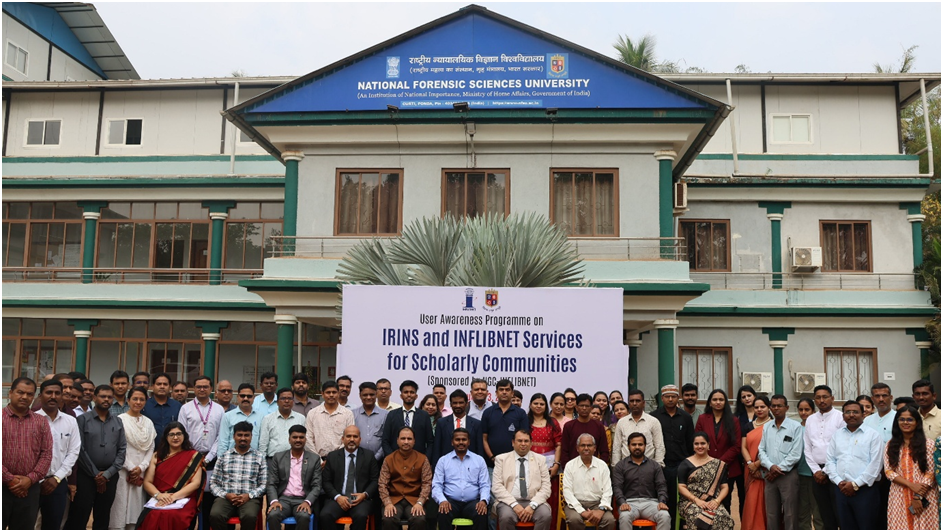
Detailed Report on Outreach Programme – IRINS, INFLIBNET Services and ONOS
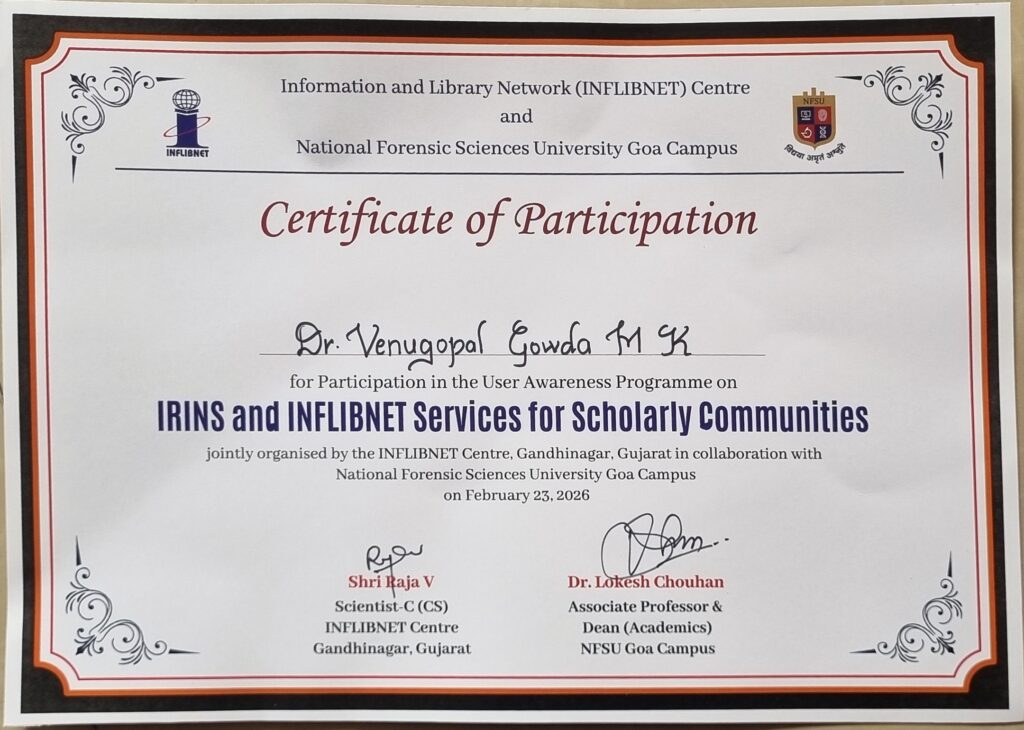
Report on Participation in Outreach Programme on IRINS, INFLIBNET Services and ONOS
Organised by NFSU Goa Campus – 23 February 2026
I had the opportunity to attend the Awareness Programme on IRINS and INFLIBNET Services conducted at NFSU Goa Campus. The programme provided a comprehensive overview of national research infrastructure initiatives developed by the INFLIBNET Centre under UGC and the Ministry of Education. The sessions covered ShodhChakra, Vidwan, ORCID and Academic Identifiers, One Nation One Subscription (ONOS), Discovery Services, InfiStats, INFED, and other research support platforms. Based on the presentations and demonstrations, I would like to present a detailed report along with recommendations for implementation in our college. This outreach programme was more connected with institutional research identification rather individual benefit of the participant.
Report on IRINS (Indian Research Information Network System) and its Institutional Relevance
During the User Awareness Programme on ONOS and INFLIBNET Services, special emphasis was given to IRINS (Indian Research Information Network System) as one of the most significant initiatives introduced by the Ministry of Education, Government of India, to systematise academic and research activities across Higher Education Institutions. The resource person clearly explained that the Government of India has initiated multiple digital platforms to bring uniformity, transparency, and accountability in academic administration, and IRINS is one such strategic and nationally important system.
IRINS is a web-based Research Information Management (RIM) service developed by the INFLIBNET Centre. The platform enables academic institutions, R&D organisations, faculty members, and scientists to collect, curate, manage, and showcase their scholarly communication activities in a centralised and structured manner. It also provides opportunities to create scholarly networks, monitor research performance, and enhance institutional visibility.
The speaker highlighted an important financial dimension. Globally, Research Information Management systems are expensive, and institutions that independently procure or develop such platforms often spend more than ₹25 lakhs per year. However, under the visionary policy of the Government of India, IRINS is offered as a “free Software-as-a-Service (SaaS)” to all Indian Higher Education and R&D institutions. This initiative removes financial barriers and ensures that even smaller institutions can access advanced research management infrastructure without additional expenditure.
IRINS supports integration with existing institutional systems such as Human Resource Management systems, course management systems, grant management systems, institutional repositories, open access databases, commercial citation databases, and scholarly publishers. This integration ensures that academic information is centralised rather than scattered across departments or systems. The platform also integrates academic identifiers such as ORCID ID, Scopus ID, and Google Scholar ID, enabling automatic ingestion of publication data from trusted sources. Seamless profile syncing with ORCID ensures international-level research visibility and accurate author identification.
The system includes advanced features such as research discovery tools, expert search capabilities, graphical visualisation of productivity, co-author network mapping, and maps of science. It incorporates citation metrics from Scopus and CrossRef, as well as altmetrics reflecting research attention on social media and other digital platforms. These multidimensional indicators help institutions assess not only publication quantity but also research impact and outreach.
From an institutional growth perspective, IRINS offers several strategic advantages. It centralises academic data, making it easier for IQAC and administrative authorities to prepare accurate reports for NAAC, NIRF, and other accreditation bodies. It enhances institutional visibility at national and international levels by showcasing faculty expertise and research strengths. It promotes accountability and encourages faculty members to maintain updated scholarly records. It supports collaboration by helping identify subject experts within and outside the institution. Most importantly, it aligns the institution with the national digital research ecosystem envisioned by the Ministry of Education.
How to Join IRINS
IRINS is available as “software as service” and is open to all Higher Education and R&D Institutions in India. To join and create an IRINS instance for an institution, the following systematic process has been prescribed:
Step 1: Submit the online instance request form available at
[https://irins.org/how-to-join](https://irins.org/how-to-join)
IRINS is not merely a digital profile management system; it is a comprehensive research governance tool initiated by the Government of India to standardise academic records, enhance transparency, improve research visibility, and strengthen institutional performance metrics. Considering its financial advantage, integration capability, analytical features, and strategic importance, adopting IRINS will significantly contribute to the academic, administrative, and reputational growth of our institution.
The resource persons of the outreach programme recommend that any institution initiate to joining IRINS at the earliest.
Report on “Access to E-Resources and Discovery” – Detailed Essay Format
As part of the User Awareness Programme on ONOS and INFLIBNET Services, an important technical session was delivered on “Access to E-Resources and Discovery” by Dr. Kruti Trivedi, Scientist D (LS), INFLIBNET Centre. The session provided a systematic understanding of how modern higher education institutions must move towards unified discovery systems to ensure effective utilisation of digital academic resources. The presentation was structured in a logical sequence, beginning with the vision of discovery services, followed by the evolution of search systems, introduction to ONOS Knowledge Finder, and concluding with usage analytics through InfiStats.
The session began with a simple but powerful vision: providing a single point of entry to all the content and services offered by the library. The speaker explained that today’s academic libraries subscribe to multiple digital resources such as journals, e-books, institutional repositories, OPACs, subscription databases, and open web sources. However, researchers often struggle because they must search each platform separately. This fragmented approach reduces efficiency and discourages effective literature exploration. Therefore, the concept of “One Search, Many Sources” was introduced as a solution to unify access and simplify research processes.
The next stage of the presentation focused on understanding what a discovery service actually is. A discovery service is a search interface that works on pre-indexed metadata and full-text documents rather than performing real-time queries across databases. Unlike federated search systems, which retrieve data live from multiple sources and may result in slower responses, discovery systems use a consolidated and unified index created through prior harvesting and indexing. This structure ensures faster search results, improved relevance ranking, and better integration of resources. The speaker clearly explained that this evolution from federated search to web-scale discovery represents a technological advancement in academic libraries.
The presentation then explained web-scale discovery systems in greater depth. These systems integrate content from major databases such as EBSCO, ProQuest, PubMed, ScienceDirect, and library catalogues into a centralised index. By consolidating metadata, MARC records, Dublin Core data, and full-text links, the system provides a comprehensive search experience. This ensures that researchers can discover resources from multiple publishers and platforms through a single search interface. Such integration transforms the library into a dynamic research gateway rather than a static repository.
Following this conceptual explanation, the speaker described various search functionalities available in discovery platforms. These include basic keyword search, advanced Boolean search, visual search, subject clustering, sorting by relevance or date, date limiters, folder saving options, and custom link integration. These advanced features empower researchers to refine their queries, conduct systematic literature reviews, and retrieve highly relevant academic materials. The ability to apply filters and refine search parameters strengthens research methodology and improves academic quality.
The session then moved to the practical implementation of discovery systems under the national initiative, specifically focusing on the ONOS Knowledge Finder. Developed by INFLIBNET as part of the One Nation One Subscription initiative, the ONOS Knowledge Finder is a centralised discovery platform built using customisedVuFind software. Its primary objective is to offer seamless discovery and access to ONOS-subscribed scholarly content from a single interface. The platform enhances the visibility, usability, and accessibility of academic e-resources across disciplines and serves as a knowledge hub for students, faculty members, and researchers.
The features of ONOS Knowledge Finder were explained in detail. It provides unified search across multiple publishers, cross-platform indexing of STEM and Social Sciences journals, direct full-text access to PDFs and HTML formats, advanced filtering options, citation export facilities, remote access compatibility through INFED, and user personalisation options . This integration ensures that subscribed journals are not merely available but actively discoverable and usable.
The final stage of the presentation focused on InfiStats, the analytical dashboard designed to monitor usage of ONOS-subscribed e-resources. InfiStats is a COUNTER-compliant usage analytics system that harvests journal usage data through SUSHI protocols. It provides institution-wise dashboards showing monthly usage, title-level downloads, login-based access statistics, and aggregate data for INFED-authenticated users. The speaker emphasised that usage analytics are essential for evidence-based decision-making. Institutions can identify which journals are frequently accessed, which resources are underutilised, and how research trends are evolving within departments.
From an institutional perspective, the systematic adoption of discovery systems and usage analytics offers multiple benefits. First, it improves research efficiency by reducing the time required to locate relevant literature. Second, it maximises the utilization of subscribed resources under ONOS. Third, it enhances the quality of research publications and dissertations by providing access to high-impact scholarly materials. Fourth, it enables data-driven planning by offering measurable evidence of resource usage. Finally, it strengthens accreditation documentation by demonstrating effective use of digital learning resources.
In conclusion, the session on Access to E-Resources and Discovery clearly illustrated that subscription alone is insufficient; discoverability and analytical monitoring are equally important. A unified search interface combined with advanced analytics ensures that digital resources contribute meaningfully to academic excellence. By actively promoting ONOS Knowledge Finder and utilisingInfiStats, our institution can significantly enhance research quality, improve resource management, and align with national digital education initiatives.
Detailed Report on One Nation One Subscription (ONOS) Initiative
(Based on the PPT Presentation by Dr. Kruti Trivedi, INFLIBNET Centre)
The presentation began by explaining the background situation prior to ONOS . Earlier, access to subscription journals was fragmented across various consortia such as eShodh Sindhu, DRDO, CeRA, ERMED, NLIST, DeLCON, DAE, NKRC, and other government-supported library groups. Different institutions negotiated subscriptions independently or through separate consortia. This resulted in duplication of expenditure, uneven access, and inequality among institutions. Smaller colleges often lacked access to high-impact international journals due to financial limitations.
Recognizing these disparities, the Government of India envisioned a unified national subscription system. This vision was aligned with the broader goal of open access transformation in India and improved research evaluation mechanisms. The initiative was formally conceptualized between 2022 and 2025 through a systematic planning process .
The genesis of ONOS began in March 2022 with a national survey of e-resource subscriptions across institutions. In June 2022, the proposal received approval from the Committee of Secretaries chaired by the Cabinet Secretary. Subsequently, a Publisher Evaluation Committee finalized a list of publishers, and multiple rounds of Request for Proposals (RFPs) and negotiations were conducted throughout 2022 and 2023. By May 2024, final negotiations were completed, and in November 2024 the Union Cabinet approved ONOS as a Central Sector Scheme for 2025–2027 . Implementation officially began in January 2025.
ONOS consolidates subscriptions from 30 major international publishers, covering more than 13,000 journal titles across 27 subject categories . These publishers include globally reputed organizations such as Elsevier, Springer Nature, Taylor & Francis, Wiley, Sage, IEEE, Oxford University Press, Cambridge University Press, ACM Digital Library, and many others. By negotiating centrally, the Government ensures equitable access to high-quality scholarly journals for institutions across India.
The scheme is funded under a Central Sector allocation of ₹6000 crore for three years (2025–2027) . This centralized funding eliminates the financial burden on individual institutions. At present, ONOS membership includes more than 6,500 government-funded institutions, including Central Universities, State Public Universities, Institutions of National Importance, Government Colleges, Inter-University Centres, and research institutions under various ministries . Currently, the service is available only to government-funded higher education and R&D institutions.
However, the phased implementation plan outlines future expansion. Phase I merges all government library consortia and integrates more public institutions. Phase II proposes inclusion of private academic institutions through a public-private partnership model. Phase III envisions universal access through designated public library access points . This indicates that in the future, ONOS services are expected to extend to the broader public, ensuring knowledge accessibility beyond institutional boundaries.
The presentation then detailed the access model under ONOS. Institutions with static IP addresses receive campus-wide automatic access, allowing all devices connected to the campus network to retrieve articles without individual registration . Off-campus access is enabled through INFED (Indian Access Management Federation) using Shibboleth authentication, ensuring secure login-based remote access. For colleges without static IP addresses, centralized Identity Provider (IDP) infrastructure is maintained at INFLIBNET, and user accounts are managed by the institutional librarian or nodal officer.
INFED ensures secure authentication and establishes trust relationships among publishers, identity providers, and user institutions. This system maintains user confidentiality while providing seamless access to subscribed content.
A significant feature of ONOS is Article Processing Charge (APC) support. Under the scheme, fully open access journals ranked in the top 5% as per CiteScore, SNIP, or SJR are eligible for APC payment support . Additionally, special read-and-publish agreements, such as with the ACM Digital Library, allow unlimited open access publishing without APCs for participating government-funded institutions. This strengthens India’s global research visibility and promotes open access publishing.
ONOS also incorporates usage monitoring through InfiStats, a COUNTER-compliant analytics platform that tracks journal usage data. This ensures accountability and evidence-based decision-making in resource utilisation. Furthermore, the ONOS Knowledge Finder provides a unified discovery platform to search subscribed content efficiently.
The joining process requires institutions to register on the ONOS portal (https://onos.gov.in/) with AISHE code and nodal officer details. Institutions without AISHE codes must first register on the AISHE portal. Existing government consortia members are automatically migrated to ensure a smooth transition.
From an institutional growth perspective, ONOS offers transformative benefits. First, it provides equal access to high-impact journals regardless of institutional size or financial capacity. Second, it improves research quality by enabling faculty and scholars to access current global literature. Third, it reduces financial expenditure previously required for individual subscriptions. Fourth, APC support enhances publication output and international research visibility. Fifth, centralised analytics enable better planning and accreditation documentation.
ONOS represents a landmark reform in India’s research infrastructure. Currently available to government-funded institutions, it aims in future phases to expand access to private institutions and eventually to the public through designated access points. By removing financial barriers and centralising negotiations, ONOS democratizes knowledge access and strengthens the foundation of academic excellence across the country.
Detailed Report on “ShodhChakra: A Gateway to Resources for Researchers”
(Based on the Presentation by Raja V, Scientist–C, INFLIBNET Centre)
The session began with reference to the UGC Guidelines dated 14th March 2022 regarding the “Implementation of Guidelines for Establishment of Research & Development Cell (RDC) in Higher Education Institutions.” As per these guidelines, every Higher Education Institution is required to create a digital portal for institutional research information and repository management. ShodhChakra was launched on 10th May 2022 by the UGC Chairman as a dedicated portal for researchers, aligned with the vision of NEP 2020 to strengthen research activities in Indian universities.
ShodhChakra is designed as a centralised research management system where all PhD research activities are managed on a single digital platformfrom admission to thesis submission. The presentation emphasised that research in many institutions currently suffers from fragmented documentation, manual records, and procedural delays. ShodhChakra addresses these issues by creating a transparent, accountable, and digitally verifiable system.
The usefulness of ShodhChakra was explained separately for universities, research scholars, and guides. For universities, it ensures centralised research management, monitoring and compliance with UGC/INFLIBNET norms, digital transparency in approvals and reviews, and easy institutional reporting for NAAC and other accreditation requirements. For research scholars, it provides end-to-end research support, including topic finalisation, literature assistance, progress tracking, thesis submission, and organised documentation in one secure location. For guides, it enables effective scholar management, structured review processes, transparent supervision, and a reduction in repetitive administrative workload.
The life cycle of a researcher within ShodhChakra is systematic. It begins with registration (self-registration or by university/nodal officer/guide), followed by verification, login access, profile creation, topic/title submission, synopsis upload, scholarship details, metadata entry, coursework completion, objective setting, interaction with the guide, and finally thesis submission. Each stage is digitally recorded, creating an auditable research trail.
One of the most significant features highlighted was the Researcher Profile module. Scholars must enter personal details, topic/title, synopsis, scholarship/fellowship information, keywords, metadata, coursework status, thesis language, and research objectives. This structured metadata ensures better discoverability and systematic documentation of research work.
ShodhChakra also provides integrated knowledge resources, including modules on research ethics, literature review, reference management systems, scientific writing, and plagiarism awareness. Through Shodhganga data integration, scholars can access thesis repositories for literature assistance. The system allows annotation of literature sources, saving favourites, aggregating resources from Google Scholar, IRINS, departmental publications, and open sources.
The platform includes RDC/RAC/DRC monitoring tools for thesis in progress, enabling committee remarks, submission tracking, and digital documentation of review meetings. Publication modules allow scholars to track journals, workshops, conferences, and add their own publications. Reference management tools support bibliography generation and download options. The thesis submission module enables uploading and tracking of documents digitally, reducing paperwork and delays.
A particularly important feature is “My Library,” which functions as a personal research drive where scholars can store documents, manage favourite resources, interact with guides, and monitor thesis progress. This transforms ShodhChakra into not merely a monitoring tool but a comprehensive research workspace.
The institutional registration process was explained in detail. Universities must download and sign a Memorandum of Understanding (MoU), signed by the Vice-Chancellor or Registrar, and send hard copies to INFLIBNET. After verification, login credentials are issued, and the university dashboard is activated . The university can then create school/faculty structures, departments, assign nodal officers, register researchers and guides (individually or in bulk), verify profiles, assign supervisors, and generate reports. Bulk import options significantly reduce administrative workload.
The system also provides comprehensive reporting modules covering schools, departments, guides, researchers, scholarship/fellowship data, and thesis status. This ensures easy preparation of reports for audits, accreditation, and statutory compliance.
Recommendations Given by the Organisers
During the session, the resource person strongly recommended that institutions should adopt ShodhChakra at the earliest in order to comply with UGC guidelines and strengthen their Research & Development Cell operations. The following key recommendations were emphasised:
- Institutions must digitalise all Ph.D. processes to ensure transparency and avoid manual record discrepancies.
- Research scholars should be mandatorily registered in ShodhChakra to maintain standardised research metadata.
- Guides should actively use the platform to monitor progress and provide timely digital approvals.
- Universities should integrate ShodhChakra with institutional repositories and other INFLIBNET initiatives such as Shodhganga and IRINS.
- Regular training sessions should be conducted for faculty, scholars, and administrative staff to ensure effective implementation.
- Institutions should utilize the reporting module for NAAC, NIRF, and other quality assessment documentation.
The organiser highlighted that ShodhChakra is not merely a software application but a comprehensive digital ecosystem for research governance. Adoption of this platform will improve research quality, reduce administrative burden, ensure regulatory compliance, enhance transparency, and strengthen institutional reputation.
ShodhChakra represents a significant reform in research management practices within Indian Higher Education Institutions. By centralizing Ph.D. lifecycle management, integrating knowledge resources, facilitating structured supervision, and enabling compliance reporting, the platform supports both academic excellence and administrative efficiency.
I respectfully recommend that our institution initiate the process of signing the MoU with INFLIBNET and adopt ShodhChakra as a structured digital research management system under the guidance of the IQAC and Research & Development Cell.
Detailed Report on Academic Identity with Reference to ORCID
(Based on the Presentation by Raja V, Scientist–C, INFLIBNET Centre)
The session began with the fundamental concept of an identifier. An identifier is a unique expression in written format, either numeric, alphanumeric, or coded, designed to distinguish one entity from another within a given system. Examples include ISBN for books, ISSN for journals, Aadhaar for citizens, and ORCID for researchers. In the academic context, identifiers ensure clarity, ownership, attribution, and interoperability within digital systems.
The resource person explained the core challenge in research careers: how to trace and connect research activities throughout a scholar’s professional life . Researchers often face issues such as name ambiguity, inconsistent spelling, institutional changes, and duplication of profiles across databases. These challenges lead to misattribution of publications, difficulty in evaluation, and reduced discoverability. Therefore, academic identifiers are essential to ensure that research outputs are correctly connected to the right individual.
The presentation then introduced the concept of Persistent Identifiers (PIDs) . Persistent identifiers provide long-term, stable references to research entities. These include DOIs for research outputs (CrossRef and DataCite), ORCID IDs for individuals, RAiDs for projects, and ROR IDs for institutions. Together, these identifiers create an interconnected research infrastructure that supports transparency, accountability, and global interoperability.
The session reviewed existing identification systems such as ISNI, ResearcherID (Web of Science), Scopus ID, RePEc, Google Scholar ID, Semantic Scholar, and VIDWAN. While these systems provide author identification within specific platforms, ORCID stands out as an independent, global, non-profit, interoperable identifier that connects multiple systems together.
ORCID (Open Researcher and Contributor Identifier) was launched in 2012 as an independent, non-profit research infrastructure service . It provides a unique 16-digit identifier expressed as a URI (e.g., https://orcid.org/0000-0002-XXXX-XXXX). It is free for researchers to register and is sustained through membership fees from organisations. ORCID is community-governed and guided by transparency and openness.
The mission of ORCID is to enable transparent and trustworthy connections between researchers, their contributions, and their affiliations. It offers three primary services: a unique ORCID iD, an ORCID record/profile containing employment, education, funding, and research outputs, and APIs that allow integration with institutional and publisher systems.
The ORCID record captures comprehensive research life data, including affiliations, professional activities, funding information, research outputs, peer reviews, research resources, and other identifiers. Importantly, researchers remain in control of their data, with permissions that can be granted or revoked at any time.
The presentation highlighted the importance of interoperability. ORCID enables institutions, publishers, funders, and discovery systems to add validated information to researcher records . For example, publishers can add peer reviews and publications; funders can add grant information; institutions can verify affiliations. Each addition includes a provenance marker, creating trust and reliability in the academic record.
Statistical data presented in the session demonstrated ORCID’s global adoption. Over 10 million active researchers are registered, with participation from more than 60 countries. The system has thousands of active integrations and organisational members worldwide. In India, adoption has begun with members such as INFLIBNET and select IITs.
The benefits for researchers were explained systematically. ORCID reliably connects scholars with their contributions and affiliations; it eliminates mistaken identity; it saves time by enabling “enter once, reuse often”; it improves discoverability; it provides a lifelong digital identity; it allows researchers to control their data; it supports compliance with funding agencies; it integrates with manuscript submission systems; and it remains free to register and use .
The practical steps for obtaining and using ORCID were also explained. Researchers must register at orcid.org, add name variants, verify email addresses, link publications using search-and-link tools (such as CrossRef and DataCite), manually add missing works if necessary, include education and employment history, and use the ORCID ID in grant applications, manuscript submissions, and dataset deposits .
The presentation also described how INFLIBNET integrates ORCID into its systems such as IRINS, VIDWAN, ShodhChakra, and institutional repositories. Through this integration, publication metadata flows from publishers to CrossRef, and from CrossRef to ORCID, and then into institutional research systems. This automated workflow ensures accurate attribution and reduces manual data entry.
From an institutional perspective, ORCID strengthens research governance. It ensures trustworthy recognition of researchers, supports transparent and data-driven decision-making, increases return on research investment, ensures accurate attribution of outputs, reduces administrative burden during accreditation exercises, and promotes interconnected infrastructure aligned with FAIR data principles .
TheRecommendations for Institutional Adoption
Based on the presentation and guidance provided by the organiser, the following recommendations are proposed for institutional implementation:
First, the institution should mandate ORCID registration for all faculty members, research scholars, and project staff.
Second, ORCID IDs should be integrated into institutional research systems such as IRINS, ShodhChakra, and the institutional repository.
Third, faculty should be instructed to include ORCID IDs in all manuscript submissions, conference papers, and grant applications.
Fourth, ORCID authentication should be incorporated into research evaluation and appraisal processes to ensure accurate publication tracking.
Fifth, awareness workshops should be conducted at departmental levels to educate scholars on linking publications and maintaining updated ORCID profiles.
Sixth, the institution should explore ORCID membership through national consortia to enable system-level integration and API-based data synchronization.
The ORCID system is not merely an identifier; it is the foundation of a modern, interconnected, transparent scholarly ecosystem. By adopting ORCID systematically, the institution can enhance research visibility, improve evaluation accuracy, reduce administrative burden, and align with global best practices in academic identity management.
I respectfully recommend that our institution initiate a structured ORCID implementation policy under the guidance of the IQAC and Research & Development Cell to strengthen our academic identity and research governance framework.
Detailed Report Section on VIDWAN ID (Expert Database and National Academic Profile System)
During the outreach programme, the resource person placed strong emphasis on the importance of VIDWAN ID for every academician and for institutional academic governance. It was clearly stated that VIDWAN is not merely a profile database but a nationally integrated expert information system that is closely linked with various Government of India academic and regulatory platforms.
VIDWAN (Expert Database and National Researcher Network) is an initiative of the INFLIBNET Centre under the Ministry of Education. It serves as a structured national database of experts working in Indian higher education and research institutions. The platform captures detailed academic profiles of faculty members including qualifications, research areas, publications, patents, projects, awards, and professional contributions.
The resource person emphasized that VIDWAN plays a central role in connecting academicians to national-level academic systems such as UGC, NAAC, NIRF, funding agencies, and other regulatory bodies. When institutions submit documents for accreditation, ranking, or compliance purposes, the verification and scrutiny of faculty research data are often cross-checked through national academic databases. VIDWAN functions as an authenticated reference source for validating faculty credentials and research output.
One of the most significant points highlighted during the programme was that when an academician applies for research funding, fellowships, project grants, or national-level academic assignments from Government agencies, the system may automatically verify the applicant’s profile through VIDWAN. This ensures transparency, authenticity, and consistency in academic records. In other words, the credibility of research claims, publication records, and expertise areas can be digitally validated through the VIDWAN database.
The resource person further explained that VIDWAN is interconnected with other INFLIBNET initiatives such as IRINS and SheRNI. When faculty members maintain updated profiles across these platforms, institutional data becomes synchronized and reliable. This integration reduces duplication, strengthens research visibility, and improves data accuracy for institutional reporting.
From an institutional perspective, encouraging all faculty members to register and regularly update their VIDWAN ID is extremely important for the following reasons:
First, it enhances the national visibility of the institution’s academic expertise. When government bodies, committees, or universities search for experts in specific disciplines, VIDWAN serves as a primary database for identifying suitable scholars.
Second, it supports accreditation and ranking processes. Since NAAC and NIRF increasingly rely on verifiable research data, having authenticated faculty profiles in VIDWAN strengthens institutional documentation.
Third, it improves eligibility for government funding. Accurate and updated VIDWAN profiles increase the credibility of faculty members applying for grants, consultancy projects, or policy assignments.
Fourth, it ensures alignment with national academic digital infrastructure. As India moves toward integrated research governance systems, platforms like VIDWAN function as backbone databases for academic validation and evaluation.
The resource person strongly recommended that institutions should not treat VIDWAN registration as optional. Instead, it should be made mandatory for all full-time faculty members. Institutions should conduct internal awareness programmes to ensure that profiles are complete, accurate, and regularly updated with publications, citations, and research achievements.
In conclusion, VIDWAN ID is a critical component of India’s academic digital ecosystem. It serves as a verification platform, expert identification system, and research visibility tool. For both individual academicians and institutions, maintaining an updated VIDWAN profile is essential for academic credibility, funding opportunities, accreditation compliance, and national recognition.
It is therefore recommended that our institution initiate a structured drive to ensure that all faculty members create and maintain their VIDWAN ID profiles and integrate them with ORCID and IRINS for comprehensive academic representation.
Detailed Report on INFLIBNET Centre – Research Support Services
(Based on the Presentation: INFLIBNET Centre – Research Support Services)
The session began with an overview of the establishment and institutional framework of INFLIBNET . The Centre was established in 1991 as a project of the University Grants Commission (UGC) and was later recognized in 1996 as an Inter-University Centre of the UGC. Functioning under the Ministry of Education, Government of India, INFLIBNET facilitates and promotes scholarly communication activities across Higher Education Institutions in India. The governance structure includes a Governing Council/Board, Director, technical staff, and administrative staff, ensuring institutional accountability and technical excellence.
The presentation then outlined the ten major verticals of INFLIBNET services . These include Library Automation, Access to Scholarly Resources, Open Access Initiatives, Scholarly Networks, e-Learning, LIS & ICT Skill Development, e-Governance at UGC, Accreditation & Ranking support, MoE Funded Projects, and Other Academic Projects. This structured classification demonstrates that INFLIBNET is not limited to library services but functions as a comprehensive digital backbone for higher education in India.
Historically, the evolution of INFLIBNET services was explained chronologically . Beginning with Library Automation in 1991, followed by E-Resources (2003), Research Support (2010), E-Learning (2011), Research Networks (2014), Ranking & Accreditation (2015), ONOS & Open Research Platforms (2025), Teacher Training Support (2023), and e-Governance expansion (2026), the Centre has consistently adapted to technological and policy developments.
UnderLibrary Automation, two major systems were highlighted: IndCat and SOUL . IndCat (Union Catalogue) provides online catalogues of books, theses, and journals from major university libraries, with more than 2.6 crore bibliographic records from over 371 universities. SOUL (Software for University Libraries) is an Integrated Library Management System with more than 4,350 installations. SOUL 3.0 was launched in February 2021, and a web preview was released in February 2025. Adoption of SOUL strengthens library management, cataloguing, circulation, and digital resource tracking within institutions.
The Access to Scholarly Resources segment emphasised ONOS (One Nation One Subscription) . ONOS has acquired national licenses from 30 major international publishers to provide equal access to high-quality academic journals. It integrates InfiStats (usage analytics), INFED (Shibboleth-based off-campus access), and Discovery Search (Knowledge Finder). The Discovery Search platform contains more than 5.02 crore records across 13,000+ journals. InfiStats provides COUNTER-compliant usage monitoring using SUSHI protocols, offering dashboard-based analytics for institutional management.
INFED was explained as a federated access management system allowing secure off-campus access to subscribed e-resources. Currently, hundreds of institutions have signed up for membership, with numerous service providers integrated. The identity of users remains protected, ensuring secure and ethical access to resources.
The Open Access Initiatives include Shodhganga, ShodhShuddhi, ShodhChakra, and related platforms . Shodhganga hosts more than six lakh full-text theses contributed by hundreds of universities. These initiatives ensure free access to doctoral research, promote transparency, reduce duplication of research, and strengthen academic integrity.
The e-Learning vertical includes ePGPathshala, Vidya-Mitra, and Swayam-Prabha . ePGPathshala offers more than 23,000 e-text modules and 23,000 videos across 70 subjects, developed by over 5,100 subject experts. Vidya-Mitra integrates tens of thousands of e-texts and videos into a unified portal. Swayam-Prabha operates 40 DTH channels and a web portal for archival tutorials, program schedules, and mobile integration. INFLIBNET serves as National Coordinator and technical partner for these initiatives.
The Learning Management Service (LMS) launched in 2020 provides more than 1,000 pre-populated course contents . Several universities have adopted this LMS, strengthening digital teaching and blended learning environments.
Under Scholarly Networks, VIDWAN and IRINS were highlighted. VIDWAN serves as a premier database of scientists and researchers, containing lakhs of expert profiles and millions of publications. IRINS functions as a Research Information Management (RIM) system for institutions, supporting publication tracking, citation analysis, and research visibility.
The launch of SheRNI (She Research Network in India) on 8th March 2024 was presented as a landmark initiative promoting visibility and recognition of women scientists . Additionally, LIB-VAHINI (launched August 12, 2025) supports library professionals and teaching communities.
In the area of Accreditation & Ranking, INFLIBNET provides digital platforms supporting NIRF, ARIIA (now NIRF-Innovation), NAAC, and e-NBA . The system includes data capturing modules, ranking dashboards, publication tracking, citation monitoring, and technical helpdesks, thereby facilitating evidence-based institutional assessment.
Under MoE Funded Projects, initiatives such as Ek Bharat Shreshtha Bharat, Fit India, Unnat Bharat Abhiyan, and the Malaviya Mission Teacher Training Programme were highlighted. INFLIBNET also supports the Raja Rammohun Roy National Agency for ISBN.
The presentation described various e-Governance portals developed for UGC and Higher Education Institutions, including DEB Portal, FRG Portal, CU Portal, HRDC, Recruitment Systems, Commission Meetings, and others. These platforms streamline administrative processes and improve transparency.
Training and outreach activities were also emphasized. INFLIBNET conducts more than 50 workshops annually, including SOUL training, user awareness programmes, PLANNER and CALIBER conventions, Open Day events, and continuous professional development initiatives. The Centre has received several national and international awards for its digital learning and open access contributions.
Institutional Recommendations
Based on the comprehensive overview presented, the following recommendations are proposed for institutional adoption:
First, our institution should adopt SOUL (if not already implemented) for comprehensive library automation.
Second, we should actively participate in ONOS and integrate INFED for secure remote access to e-resources.
Third, faculty and research scholars should deposit theses in Shodhganga and utilize ShodhChakra for research lifecycle management.
Fourth, ORCID and IRINS integration should be encouraged for accurate research tracking and visibility.
Fifth, departments should actively use ePGPathshala, Vidya-Mitra, and LMS resources to strengthen blended learning.
Sixth, data required for NAAC, NIRF, and accreditation should be systematically captured through INFLIBNET-supported platforms.
Seventh, regular faculty development workshops should be organised in collaboration with INFLIBNET outreach programmes.
The INFLIBNET Centre functions as the digital research and academic infrastructure backbone of Indian higher education. Its services span library automation, research management, scholarly networking, e-learning, accreditation support, and national-level e-governance systems. Adoption and active utilisation of these services will significantly strengthen institutional research capacity, academic governance, transparency, and national visibility.

You may also like

Digital Marketing Industry Trends and Future opportunities
Digital Marketing Guest Session