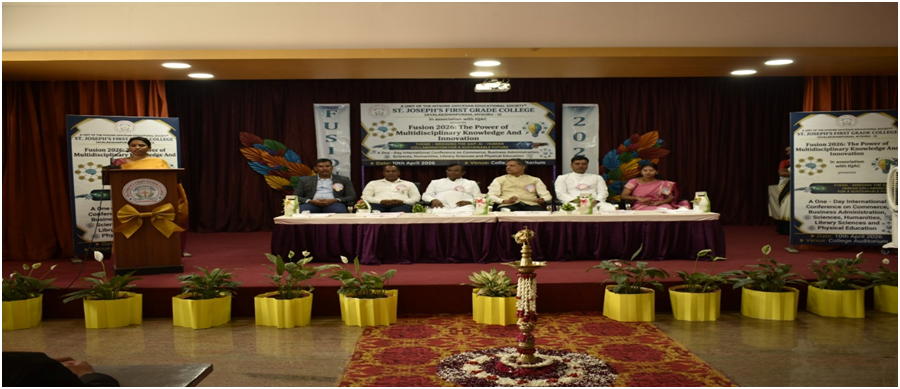
Report on Technical Session – Fusion 2026: The Power of Multidisciplinary Knowledge & Innovation
Date: April 10, 2026
Venue: St. Joseph’s First Grade College, Mysuru (Hybrid Mode)
Theme: “Bridging the Gap: AI–Human Collaboration for a Sustainable Future”
The one-day international conference Fusion 2026: The Power of Multidisciplinary Knowledge & Innovation, organized by St. Joseph’s First Grade College, Mysuru, on April 10, 2026, featured an insightful and thought-provoking technical session during the morning hours. This session brought together distinguished speakers from academia and industry who shared their perspectives on the evolving role of Artificial Intelligence (AI) in shaping the future of work, society, and sustainability.
The central focus of the technical session revolved around two key ideas: the impact of AI on employment—particularly the possibility of job displacement and creation—and the importance of AI–human collaboration in achieving a sustainable future. The speakers provided a balanced and realistic understanding of how AI is transforming the global workforce and emphasized the need for adaptability, reskilling, and ethical integration of technology.
The session commenced with an overview of how AI has rapidly advanced in recent years, becoming an integral part of various sectors such as healthcare, education, finance, manufacturing, and agriculture. The speakers highlighted that AI is no longer a futuristic concept but a present-day reality influencing decision-making, automation, and productivity across industries. They pointed out that repetitive, routine, and data-driven tasks are increasingly being handled by AI-powered systems, leading to concerns about job displacement.
One of the key discussions in the session centered on the notion that AI is likely to replace certain types of jobs, particularly those that involve predictable and repetitive activities. Roles such as data entry operators, routine customer service representatives, and basic administrative functions are gradually being automated through AI technologies like chatbots, robotic process automation, and machine learning algorithms. The speakers explained that while this shift may lead to short-term disruptions in the job market, it is part of a broader technological evolution that has been witnessed in previous industrial revolutions as well.
However, the speakers strongly emphasized that AI is not merely a job-destroying force but also a significant job creator. They highlighted that the rise of AI is generating new employment opportunities in areas such as data science, machine learning engineering, AI ethics, cybersecurity, and digital transformation. In addition, roles that require human judgment, creativity, emotional intelligence, and complex problem-solving are expected to grow in importance. The speakers noted that jobs will not disappear entirely but will evolve, requiring individuals to upgrade their skills and adapt to changing demands.
A significant portion of the session was devoted to discussing the importance of reskilling and upskilling. The speakers stressed that educational institutions and policymakers must play a proactive role in preparing individuals for the future workforce. Emphasis was placed on interdisciplinary learning, digital literacy, and continuous skill development. Students and professionals were encouraged to embrace lifelong learning and to develop competencies that complement AI technologies rather than compete with them.
The discussion then shifted towards the concept of AI–human collaboration, which was identified as the key to achieving a sustainable and inclusive future. The speakers highlighted that AI should be viewed as a tool that enhances human capabilities rather than replacing them entirely. By combining the computational power of AI with human creativity and ethical reasoning, it is possible to address complex global challenges such as climate change, resource management, healthcare accessibility, and social inequality.
Several examples were shared to illustrate effective AI–human collaboration. In healthcare, AI can assist doctors in diagnosing diseases more accurately and quickly, while human expertise ensures empathetic patient care. In agriculture, AI-driven tools can optimize crop production and resource utilization, while farmers provide contextual knowledge and decision-making. Similarly, in education, AI can personalize learning experiences, while teachers play a crucial role in mentoring and guiding students.
The speakers also emphasized the importance of ethical considerations in AI implementation. Issues such as data privacy, algorithmic bias, and accountability were discussed in detail. It was highlighted that while AI has the potential to bring significant benefits, it must be developed and used responsibly to ensure fairness, transparency, and inclusivity. The role of human oversight in monitoring AI systems was stressed as essential to prevent misuse and unintended consequences.
Another important aspect discussed during the session was the role of AI in promoting sustainability. The speakers explained how AI can contribute to achieving sustainable development goals by improving efficiency, reducing waste, and enabling better decision-making. For instance, AI can optimize energy consumption, enhance supply chain management, and support environmental monitoring. The integration of AI with sustainable practices was presented as a powerful approach to addressing global environmental challenges.
Overall, the technical session was highly informative and insightful. It provided participants with a comprehensive understanding of the dual impact of AI on employment and highlighted the importance of adapting to technological changes. The emphasis on AI–human collaboration as a pathway to sustainability was particularly valuable, encouraging participants to view technology as an enabler rather than a threat. The session successfully inspired attendees to explore innovative ways of integrating AI into their respective fields while maintaining a focus on ethical responsibility and sustainable development.
We, representing the PG Department of Commerce, St. Philomena’s College, actively participated in this prestigious conference and successfully presented our research paper titled “Human-Centred Artificial Intelligence (HCAI) and Sustainable Urban System: The Mediating Role of Citizen Participation in Achieving Sustainable Development Goal 11.” The paper was co-authored by Dr. Viveka Marie G., Assistant Professor and Head, and Harshitha Bai M as a student researcher.
The objective of our study was to explore the role of Human-Centred Artificial Intelligence in enhancing sustainable urban systems, with a special focus on the mediating role of citizen participation. The research aimed to analyse how AI technologies, when designed with a human-centric approach, can contribute to solving urban challenges such as pollution, traffic congestion, and inefficient resource management. The study also emphasized the importance of citizen involvement in governance and decision-making processes to achieve sustainable development goals, particularly SDG 11, which focuses on sustainable cities and communities.
The research was based on both descriptive and inferential design, using primary and secondary data. A structured questionnaire was used to collect data from 203 respondents in Mysuru city through stratified sampling. Statistical tools such as percentage analysis, reliability test, correlation analysis, regression analysis, and multicollinearity test were applied using SPSS software to ensure accuracy and validity of the results.
During the presentation, we highlighted the research gap, noting that while several studies have examined artificial intelligence and smart cities, very few have focused on Human-Centred AI in the context of sustainable urban systems. Additionally, limited research has explored the mediating role of citizen participation in strengthening the relationship between AI and sustainability outcomes. This made our study relevant and significant in the current academic and practical context.
The findings of the study revealed that Human-Centred Artificial Intelligence has a significant positive impact on sustainable urban systems. It was also observed that HCAI enhances citizen participation by promoting transparency, inclusiveness, and engagement in urban governance. Furthermore, citizen participation was found to have a strong influence on sustainable urban development. The mediation analysis confirmed that citizen participation partially mediates the relationship between HCAI and sustainable urban systems, indicating that active public involvement strengthens the effectiveness of AI-driven solutions.
The presentation session was interactive and intellectually stimulating. The panel of experts provided valuable feedback and appreciated the relevance of the topic in the context of modern urban challenges. The conference also offered an excellent platform to interact with researchers and academicians from diverse fields, which helped in gaining insights into multidisciplinary approaches to problem-solving.
Overall, participating in this international conference was a highly enriching experience. It enhanced our research presentation skills, improved our understanding of emerging concepts such as Human-Centred AI, and provided exposure to current trends in sustainable development. The event also motivated us to engage in further research and contribute to academic knowledge in meaningful ways.
In conclusion, the paper presentation at St. Joseph’s First Grade College was a significant academic milestone. It not only provided an opportunity to showcase our research work but also helped in broadening our perspective towards integrating technology and human participation for achieving sustainability. The knowledge gained and the experience acquired through this conference will be highly beneficial for our future academic and professional endeavours.

You may also like

Global Running Day
Student Exchange Program