INDUSTRIAL VISIT TO
FABLAB KERALA, KOCHI
INDUSTRIAL VISIT REPORT
Objectives of the Visit
The Industrial Visit to FabLab Kerala and Kerala Startup Mission (KSUM), Kochi was organized with the following objectives:
- To provide practical exposure to emerging technologies such as Artificial Intelligence, Internet of Things (IoT), Robotics, 3D Printing, Digital Fabrication, and Embedded Systems.
- To understand the role of innovation and entrepreneurship in transforming ideas into successful products, services, and startup ventures.
- To familiarize students with the startup ecosystem and the support mechanisms provided by Kerala Startup Mission for aspiring entrepreneurs.
- To gain insights into modern product development processes, including ideation, prototyping, testing, and commercialization.
- To observe the functioning of advanced fabrication laboratories and understand the applications of digital manufacturing technologies in various industries.
- To learn about incubation, mentoring, funding, and business development opportunities available for technology-based startups.
- To bridge the gap between academic learning and industry practices by exposing students to real-world technological innovations and entrepreneurial environments.
- To encourage creativity, innovation, and problem-solving skills among students through interaction with startup founders, innovators, and technology experts.
- To understand the importance of research, design thinking, and technological innovation in addressing real-world challenges.
- To motivate students to explore career opportunities in startups, technology development, research, and entrepreneurship.
Itinerary and Activities
Day 1: Friday, 29 May 2026
- The journey commenced from Mysore towards Kerala at 6.30pm from St. Philomena’s College.
- Dinner was arranged at Muthanga.
Day 2: Saturday, 30 May 2026
Morning
- Refreshments were provided at Bed Plus, Kalamassery.
· It was followed by the visit to FabLab Kerala.
Industrial Visit to FabLab Kerala
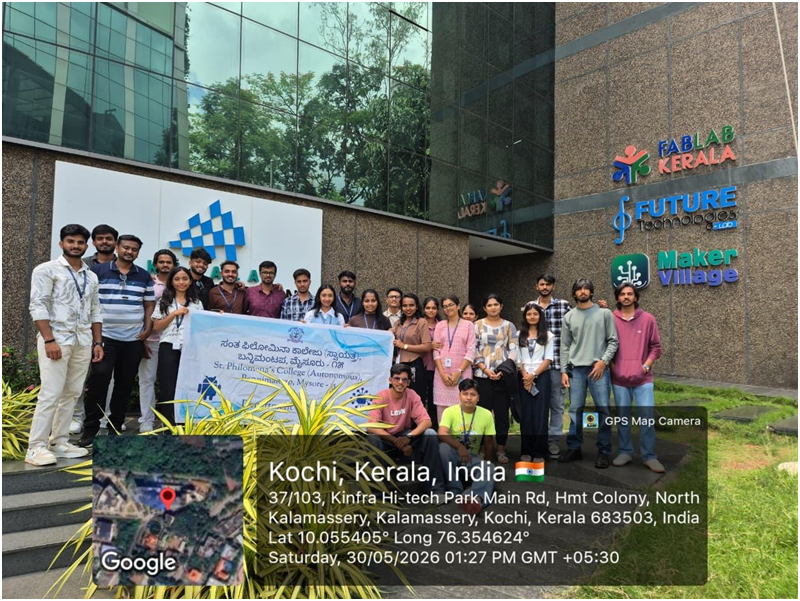
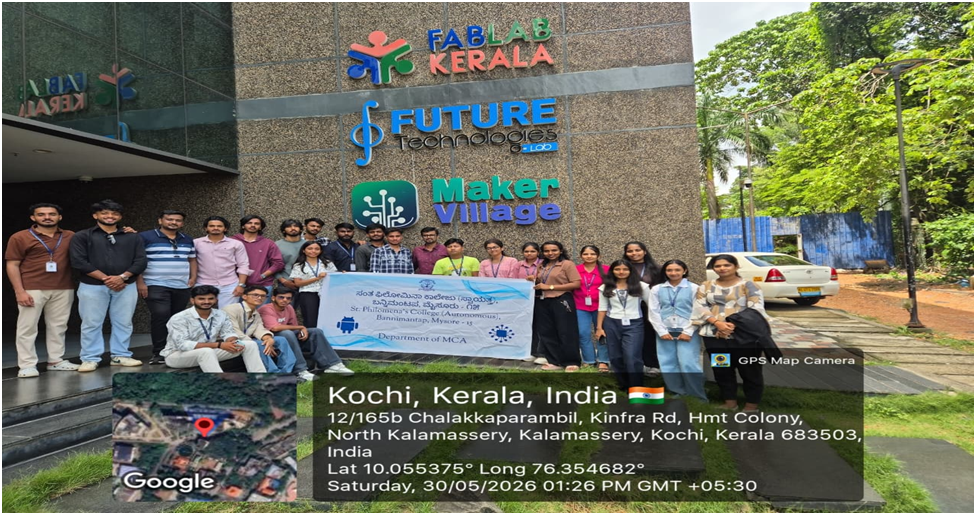
As part of the academic curriculum, the students of the Department of MCA, St. Philomena’s College (Autonomous), Mysore, visited Fab Lab Kerala on 30th May 2026. Located at KINFRA Hi-Tech Park, Kalamassery, Kochi, the facility operates under the Kerala Startup Mission (KSUM) in collaboration with the Center for Bits and Atoms, MIT (USA).
Fab Lab Kerala is a state-of-the-art digital fabrication facility that provides access to advanced manufacturing technologies, innovation tools, and prototyping equipment. The visit offered students valuable exposure to modern manufacturing processes, product development methodologies, and emerging technologies.
About Fab Lab Kerala
Fab Lab (Fabrication Laboratory) is a concept developed by MIT to provide access to advanced digital fabrication tools for innovation, research, and product development. The facility supports both Additive Manufacturing and Subtractive Manufacturing technologies and serves as a hub for innovators, entrepreneurs, and students.
Fab Lab Kerala also conducts Fab Academy, an internationally recognized program in digital fabrication that provides hands-on training in advanced manufacturing technologies.
1. Additive Manufacturing (3D Printing)
Students were introduced to modern 3D printing technologies used for rapid prototyping and product development.
- PolyJet Printing: Produces highly accurate, smooth, and detailed prototypes with the ability to create flexible and transparent models.
- Fused Deposition Modeling (FDM): A cost-effective technology that builds objects layer by layer using thermoplastic materials.
The demonstration highlighted the role of software tools such as Slicer Software and G-Code Generators in converting digital designs into printable models.
2. Subtractive Manufacturing
The visit provided insights into advanced material removal processes used in industrial production.
Key technologies demonstrated included:
- ZUND Flat Cutter for precision cutting of various materials.
- Electric Discharge Machine (EDM) for high-precision machining of conductive materials.
- Waterjet Cutting Machine for cutting metals, wood, stone, and other materials using high-pressure water.
- Injection Molding Machine for large-scale production of components.
- TRAK DPM RX2 Milling Machine and Five-Axis CNC Milling Machine for manufacturing complex parts and molds.
Students also learned the importance of G-Code programming and the integration of CAD/CAM software, particularly Fusion 360, in modern manufacturing.
3. Electronics Prototyping and PCB Manufacturing
The electronics prototyping section introduced students to the complete PCB development process.
The stages demonstrated included:
- Circuit design and simulation using E-CAD software.
- PCB fabrication and cutting.
- Automated component placement using Pick-and-Place machines.
- Soldering using Reflow Ovens.
- Testing and validation of assembled boards.
This session provided practical insights into electronic product development and hardware manufacturing workflows.
Afternoon
- The group proceeded to Marine Drive, Kochi, one of the city’s prominent waterfront destinations.
- Lunch was arranged at Fort Kochi.
Evening
- Dinner was served at Oonukal.
- The group proceeded to Ghala Residency, Anachal, Munnar, where accommodation was arranged for the night.
Day 3: Sunday, 31 May 2026
Morning
- Breakfast was served at Ghala Residency, Anachal.
Visit to Viewpoints Around Munnar
Students visited several scenic viewpoints in and around Munnar.
Afternoon
- Lunch was arranged at Anayiranghal.
Evening
- Dinner and overnight stay were at Ghala Residency, Anachal.
Day 4: Monday, 01 June 2026
Morning
- Breakfast was served at Ghala Residency, Anachal.
Visit to Chunayamakkal Waterfalls
Students visited Chunayamakkal Waterfalls, a significant natural attraction.
Visit to Rainbow Adventures, Thekkumkanam
Students observed and participated in adventure tourism activities.
Afternoon
- Lunch was arranged at Anachal.
Visit to Mattupetty Dam
Students visited the famous Mattupetty Dam.
Visit to Ripple Tea Factory
The group visited Ripple Tea Factory, where students observed various stages of tea production.
Evening
- Dinner was served at Oonukal.
- The return journey to Mysore commenced.
Day 5: Tuesday, 02 June 2026
- The team safely reached Mysore at approximately 11:00 AM, marking the successful completion of the visit.
Key Takeaways
- Understanding the role of sensors and actuators in the manufacturing industries.
- Understanding of modern digital fabrication and manufacturing technologies.
- Exposure to industrial-grade 3D printing, CNC machining, and PCB production processes.
- Familiarity with CAD/CAM tools, G-Code programming, and product prototyping workflows.
- Knowledge of embedded systems, automation, and IoT-related hardware development.
- Insight into innovation, entrepreneurship, and startup-driven product development.
Conclusion
The industrial visit to Fab Lab Kerala was a highly informative and enriching experience for the MCA students. It provided practical exposure to advanced manufacturing technologies, electronics prototyping, and embedded systems development. The visit successfully bridged the gap between classroom learning and industrial practices, enhancing students’ technical knowledge, innovation mindset, and understanding of real-world product development processes. The experience will serve as a valuable foundation for future academic projects, research activities, and professional careers in technology and innovation.