CASE HISTORY TAKING, MENTAL STATUS EXAMINATION (MSE) AND
PSYCHOPATHOLOGICAL FORMULATION
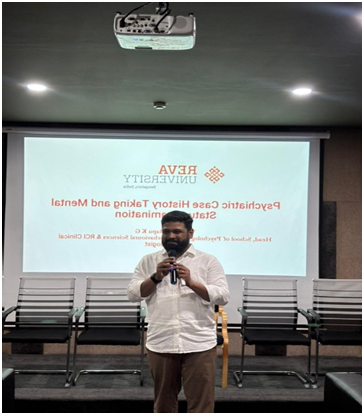
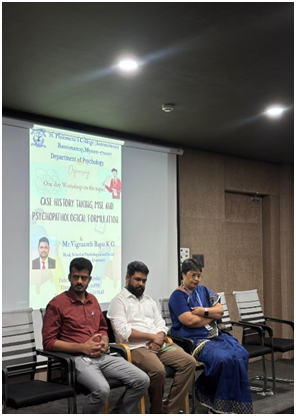
The Department of Psychology at St. Philomena’s College (Autonomous), Mysuru,organized a one-day workshop on “Case History Taking, Mental StatusExamination (MSE) and Psychopathological Formulation” on 15th November2025 at the MBA Conference Hall.
Objectives of the program
General Objectives
- To enhance participants’ clinical skills in gathering comprehensive psychological case histories.
- To develop competence in conducting and interpreting the Mental Status Examination.
- To strengthen the ability to formulate psychopathology based on case data and MSE findings.
- To integrate theoretical knowledge with practical application in clinical settings.
Specific Objectives
- Case History Taking
- Understand the importance of case history in psychological assessment.
- Learn systematic methods for eliciting personal, medical, family, and psychosocial history.
- Practice effective communication and interviewing techniques to build rapport with clients.
- Mental Status Examination (MSE)
- Identify and assess key domains of MSE (appearance, behavior, speech, mood, thought, perception, cognition, insight, judgment).
- Differentiate between normal and abnormal findings in each domain.
- Document MSE findings in a clear, structured format.
- Psychopathological Formulation
- Apply case history and MSE data to construct a coherent psychopathological formulation.
- Recognize patterns of symptoms and link them to diagnostic categories.
- Develop hypotheses about underlying psychological mechanisms and contributing factors.
- Practice writing concise, clinically useful formulations.
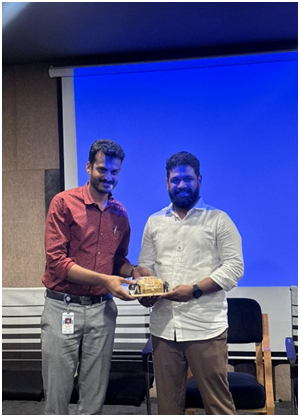
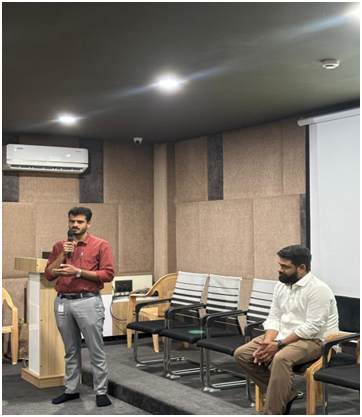
The workshop was coordinated by the Head ofthe Department, Dr. Ginson George, along with the support of UG and PG facultymembers. The programme began at 9:30 AM, with Saniya serving as the host ofthe workshop and Nandana delivering the welcome speech, followed by Shabilintroducing the resource person and chief guest, Mr. Vigraanth Bapu K. G., Headof the School of Psychological and Social Sciences, Reva University, along withthe presence of PG coordinator Noor Mubasheer ma’am. The workshop witnessedenthusiastic participation from almost all M.Sc. Psychology students, 34 in number.
The first halfof the session focused on case history taking, during which the resource personprovided detailed guidance on how to ask questions clearly, establish rapport, anddocument client information systematically. He emphasized the importantcomponents of case history, shared a structured format, and explained how todevelop a genogram to understand interpersonal dynamics.
The session was highlyinteractive, with students actively engaging in discussions and clarifying doubtsuntil the lunch break. After lunch, the workshop shifted to Mental StatusExamination, where the facilitator highlighted the importance of observingappearance, body language, affect, speech, thought processes, insight, andjudgment. To make the concepts more realistic, he demonstrated how clients withdifferent psychopathologies may behave, helping students better understandclinical presentation. The workshop offered several key takeaways, including thesignificance of clear and empathetic questioning, the value of structureddocumentation, the role of observational skills in assessment, and the need forsensitivity while interacting with clients. The programme concluded at 5pm with a vote ofthanks by Sivani, and the students shared positive feedback about the workshop.

You may also like
Mental Health Day
Gender Sensitivity for a Sustainable Tomorrow