Report on Orientation Programme: Research Career Prospects in Mathematics
Event Overview
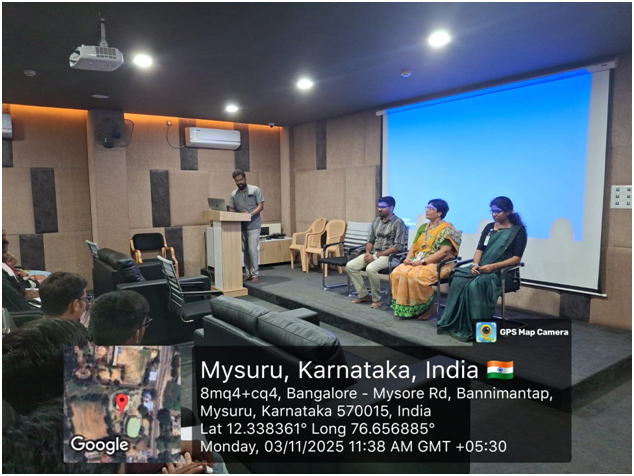
As the Convener of the Orientation Programme organized by the Postgraduate Department of Mathematics at St. Philomena’s College, Bannimantapa, Mysore, I am pleased to present this detailed report on the event held on November 3, 2025. The programme was designed to guide M.Sc. Mathematics students and recent graduates on potential career paths in research, particularly focusing on opportunities after completing their master’s degree. The session aimed to address common uncertainties faced by students regarding advanced studies, competitive exams, funding options, and long-term prospects in academia and research.
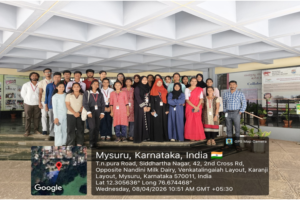
The event took place in the college auditorium from 10:00 AM to 12:30 PM, attracting an enthusiastic audience of approximately 40 participants including 35 postgraduate students, 5 faculty members from the department. The programme was structured to include an inaugural address, the main presentation by the guest speaker, an interactive Q&A session, and a vote of thanks.
Guest Speaker
The keynote speaker for the event was Dr. David A. Kalarkop, Assistant Professor in the Department of Mathematics at St. Joseph’s University, Bengaluru. Dr. Kalarkop is a distinguished academic with extensive experience in mathematical research and teaching and he has authored significant research articles on Chromatic and domination concepts of Graph theory. His personal journey in Mathematics added a relatable and motivational dimension to the session, making it particularly engaging for the audience.
Programme Schedule
10:00 AM – 10:15 AM:
Inaugural Address by the Head of the Department, welcoming the speaker and participants, and outlining the importance of research-oriented careers in Mathematics.
10:15 AM – 11:45 AM:
Main Presentation by Dr. David A. Kalarkop on “Research Career Prospects in Mathematics,” using a PowerPoint slides for visual aid.
11:45 AM – 12:15 PM:
Interactive Q&A Session, where students raised queries on exam preparation, fellowship applications, and balancing research with financial stability.
12:15 PM – 12:30 PM:
Vote of Thanks by the Convener, and refreshments.
Key Highlights from the Presentation
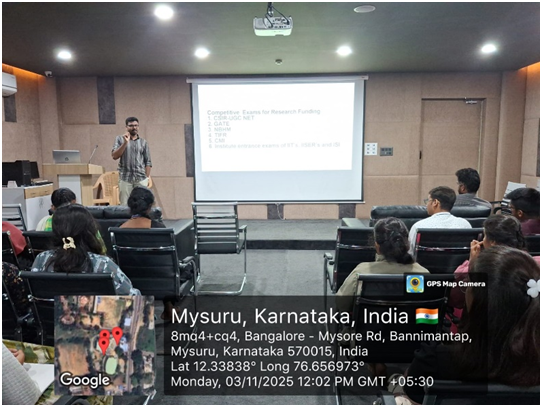
Dr. Kalarkop’s presentation was insightful and structured around his personal experiences and practical advice for aspiring researchers. The slides provided a clear roadmap for students contemplating post-M.Sc. options. Below is a detailed summary of the content covered
Introduction and Personal Motivation
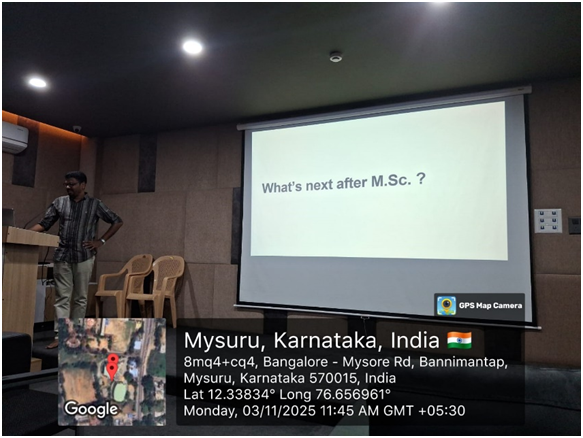
The session began with Dr. Kalarkop sharing his own story of pursuing mathematics after M.Sc., emphasizing the common dilemma: “What’s next after M.Sc.?” He recounted his initial uncertainties and how he decided to pursue a Ph.D., highlighting the passion for discovery as a driving force. This personal anecdote resonated with the audience, setting a motivational tone.
Value of Pursuing a Ph.D.
A key discussion point was whether a Ph.D. is worth the 5-year commitment without immediate financial support. Dr. Kalarkop addressed this by outlining the long-term benefits, such as intellectual fulfillment, career stability in academia, and contributions to the field.
Competitive Exams for Research Funding
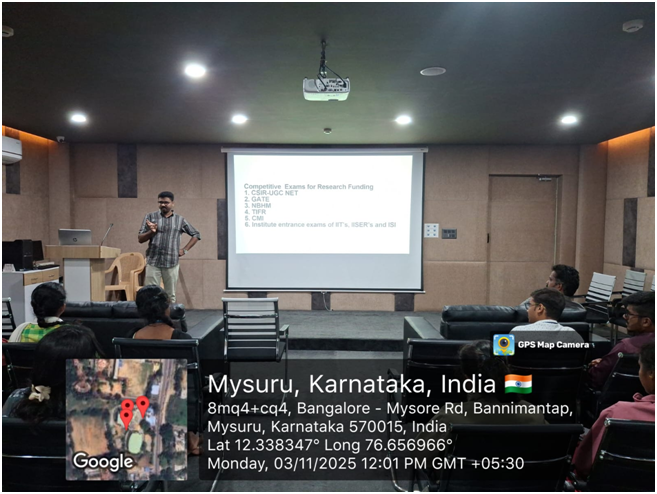
Dr. Kalarkop listed and explained major competitive exams that provide funding for research:
1. CSIR-UGC NET
2. GATE
3. NBHM
4. TIFR
5. CMI
6. Institute entrance exams of IITs, IISERs, and ISI
He delved deeper into the CSIR-UGC NET for Mathematics, covering eligibility (open to M.Sc. graduates or final-year students), syllabus, question paper pattern, cut-offs, and fellowship amounts.
Syllabus for CSIR-UGC NET Mathematics
The syllabus was presented in units:
Unit 1: Real Analysis and Linear Algebra
Unit 2: Complex Analysis, Modern Algebra
Unit 3:Differential Equations, Numerical Analysis, Calculus of Variation, Classical Mechanics
Unit 4: Descriptive Statistics, Data Analysis
Question Paper Pattern
The exam totals 200 marks with the following structure:
Part A : General Aptitude questions (MCQ)
Any 15 out of 20 (0.25 negative marking) 2 marks each
Part Any 25 out of 40 (0.75 negative marking) 3 marks each
Part C |Subject questions (MSQ) , Any 20 out of 60 (No negative marking) 4.75 marks each
Fellowship Amounts
For qualifiers:
– JRF (initial two years): Rs. 37,000 per month + Rs. 6,000 HRA
– SRF (next three years): Rs. 42,000 per month + Rs. 6,000 HRA
– Annual contingency grant: Rs. 20,000
Post-Qualification Opportunities
After qualifying exams, Dr. Kalarkop discussed pursuing Ph.D. research either abroad or in India:
Abroad: Scholarships like Marie Sklodowska-Curie Actions (3000-5000 Euros/month), Fulbright-Nehru Doctoral Fellowship, DAAD (1300 Euros), and university-specific options.
India: Fellowships via NET-JRF, GATE, NBHM, or PMRF.
Post-Ph.D. Pathways
The presentation covered postdoctoral fellowships as the next step, leading to careers in teaching and research. Dr. Kalarkop concluded with a quote from Simeon Poisson: “Life is good for only two things, discovering mathematics and teaching mathematics,” inspiring the audience to view mathematics as a fulfilling lifelong pursuit.
Conclusion
The Orientation Programme was a resounding success, providing valuable guidance to budding Mathematicians. On behalf of the PG Department of Mathematics, St. Philomena’s College, I extend sincere thanks to Dr. David A. Kalarkop for his enlightening presentation, the organizing committee for their efforts, and all participants for their enthusiasm. Such initiatives will continue to foster academic growth in our institution.

You may also like

Anti-Dowry Initiative
Regional Museum of Natural History Mysore