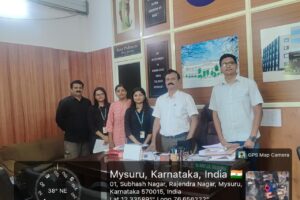
Detailed Report of One Day National Level Seminar
Introduction to Fractional Calculus (Hybrid Mode)
The PG Department of Mathematics at St. Philomena’s College successfully organized a One Day National Level Seminar on “Introduction to Fractional Calculus” in hybrid mode on 01 April 2026. The seminar aimed to provide participants with a comprehensive understanding of the fundamentals of fractional calculus, its evolution from classical calculus, and its wide-ranging applications in science, engineering, and interdisciplinary research.
The online mode was made through the google meet with the link
https://meet.google.com/nxh-myyr-dzt.
It attracted academicians, faculty members, research scholars, and students from various institutions across the country, who joined both in offline and online modes. The event served as an excellent platform for knowledge dissemination and intellectual engagement in this emerging and powerful branch of Mathematics. In total there were 56 online participants and 32 offline participants.
Mrs.ShruthiMenezes, Head of the UG Department of Mathematics, welcomed the gathering and extended warm greetings to all participants attending in physical and virtual modes.
Inaugural Session (10:00 AM – 10:30 AM)
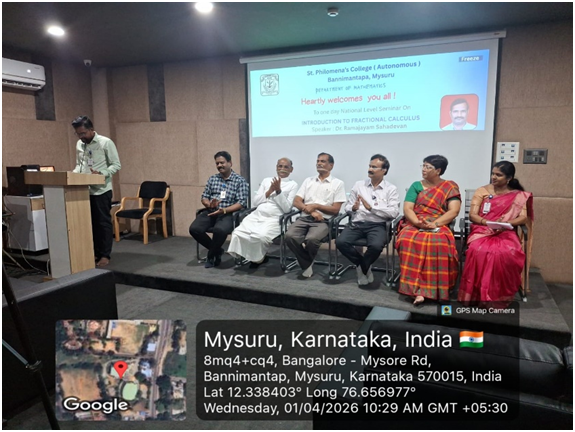
The programme began with a solemn tribute to the great Indian mathematician SrinivasaRamanujan, followed by an invocation song. Dignitaries on the dais included:
Rev. Father Lourdu Prasad Joseph, Dr. Ravi J. D. S. Saldhana, Principal, St. Philomena’s College
Dr. Noor Mubhasheer, PG Coordinator, Mr. Thomas Gunasheelan, IQAC Coordinator
Dr.Bharatha K, Head of the PG Department of Mathematics and Convener of the seminar
Mrs.ShruthiMenezes, Head of the UG Department of Mathematics
Dr. R. Sahadevan, Former Dean (Research), University of Madras, and the esteemed Resource Person
The inaugural session set a formal and inspiring tone for the academic deliberations.
Session I: Foundations of Mathematics and Classical Calculus (10:30 AM – 11:45 AM)
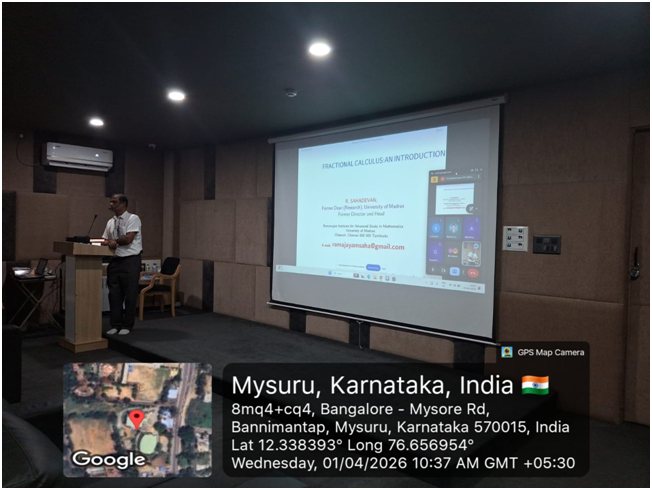
Photo 2: Prof. R. Sahadevan expressing his views in the first technical l session
Dr. R. Sahadevan delivered the first session, providing a broad and insightful overview of Mathematics and the evolution of Calculus. He began by highlighting the fundamental importance of mathematics as the “language of Nature,” emphasizing its role in understanding patterns, numbers, change, shapes, symmetry, and probability. He explained how mathematical training disciplines the mind and develops logical and critical reasoning, analytical and problem-solving skills, and the ability to make better decisions.
Dr.Sahadevan illustrated real-world relevance through examples such as ATM cash dispensation using partition of numbers, PIN security and number theory, encoding/decoding, and applications like MRI (using the Inverse Function Theorem).
The session delved into classical calculus, covering functions of one variable, derivatives as rates of change and slopes of curves, and their applications in optimization, economics, physics, and engineering. He presented practical examples, including maximizing the volume of an open-topped box from a rectangular sheet, optimizing luggage dimensions for airlines, and modeling continuous compounding with withdrawals in banking. These examples demonstrated how first-order ordinary differential equations (ODEs) model dynamic systems in physics, biology, and economics.
Participants gained a clear appreciation of the foundational role of integer-order derivatives and integrals in scientific modelling and real-life problem solving.
Session II: Introduction to Fractional Derivatives (12:00 PM – 1:15 PM)
In the post-lunch session, Dr.Sahadevan introduced the core concepts of Fractional Calculus. He defined it as a generalization of ordinary differentiation and integration to arbitrary (non-integer) orders.
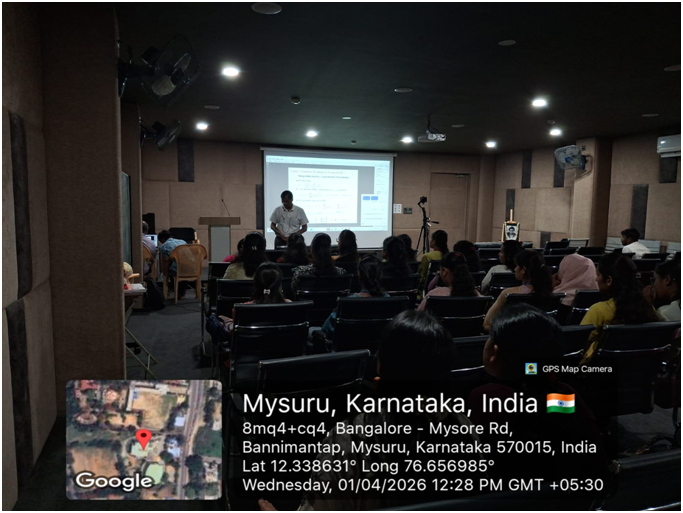
Photo 3: Prof. R. Sahadevan expressing his views in the second technical l session
The speaker traced the historical background, noting its origins in the 17th-18th century correspondence between Leibniz and L’Hôpital, where the idea of a “fractional derivative” was first pondered. He quoted Leibniz’s famous remark about the apparent paradox that would one day yield useful consequences.
Key topics covered included:
– Important definitions and properties of fractional operators (Riemann-Liouville, Caputo, etc.)
– Extension of classical operators to fractional orders
– Differences between integer-order and fractional-order derivatives
– Basic mathematical framework and notations
This session built a strong conceptual bridge from classical calculus to its fractional counterpart, clarifying how fractional derivatives capture memory effects and hereditary properties in systems, which classical models often fail to describe adequately.
Session III: Applications of Fractional Calculus with Research Orientation (2:00 PM – 3:15 PM)
The final technical session focused on the applications of fractional calculus, oriented towards research and interdisciplinary domains. Dr.Sahadevan highlighted how fractional models are increasingly used in:
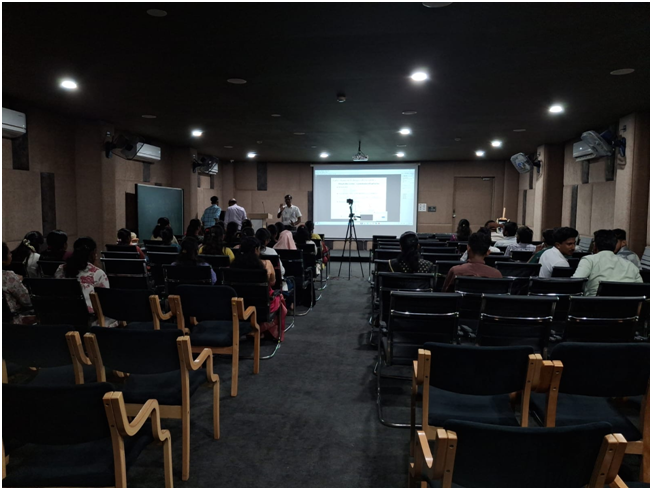
Photo 4: Prof. R. Sahadevan expressing his views in the third technical session
– Viscoelasticity (modeling materials with both elastic and viscous properties using fractional derivatives instead of classical Hooke’s law)
– Control systems and dynamical systems with memory
– Signal processing and image processing
– Anomalous diffusion models in physics and biology
– Biological sciences, finance, economics, and complex systems
– Systems exhibiting self-similar structures
He emphasized that fractional calculus provides powerful tools for modeling phenomena with long-range memory and non-local effects, making it highly relevant in modern science and engineering. Students and research scholars were particularly motivated to pursue advanced studies and research in this vibrant field, which has seen growing acceptance with dedicated journals, conferences, and thousands of publications.
The sessions were highly interactive, with participants engaging through questions and discussions.
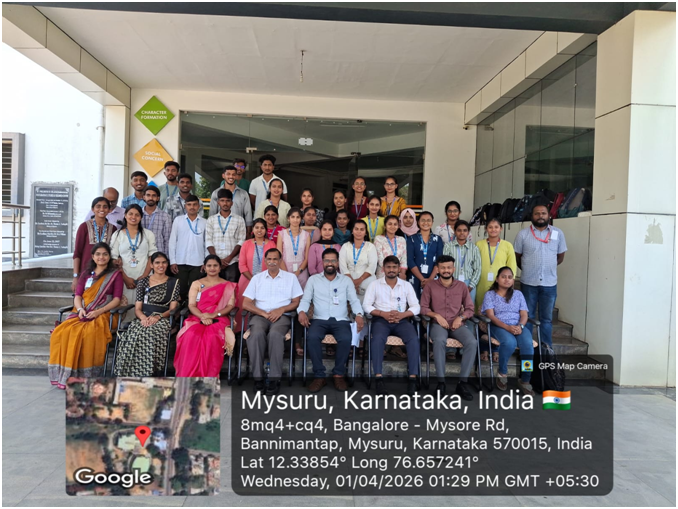
Photo 5: Group photo of the Participants
Feedback and Suggestions
Feedback was given by the participants and a few of them expressed their views in organising a fe w more such events to understand the Mathematics and its allied subjects in a clear way. A few of them expressed their opinions to conduct a workshop for a week for the deeper understanding of the subjects. The feedback was taken positively by the department
Conclusion
The One Day National Level Seminar on “Introduction to Fractional Calculus” was highly informative, intellectually stimulating, and academically enriching. Participants appreciated the clarity, depth, and practical relevance of Dr. R. Sahadevan’s presentations, which seamlessly connected foundational mathematics to cutting-edge applications.
In the context of the seminar on “Introduction to Fractional Calculus” by Dr. R. Sahadevan, the progression from classical calculus (functions of one variable, ODEs, optimization examples like box volume or airline luggage) to fractional operators makes perfect sense. Classical models provide the foundation, while fractional extensions address real-world complexities—such as memory in viscoelasticity, anomalous diffusion in MRI (mentioned in the PPT), or hereditary effects in biological and financial systems—that Dr.Sahadevan highlighted in the applications session.
Fractional calculus bridges pure mathematics with practical problem-solving, motivating students and researchers toexplore this vibrant field.
Fractional calculus is no longer a mathematical curiosity; it is a versatile framework for understanding and controlling complex, memory-dependent systems across disciplines. Its ability to model “in-between” behaviors gives it unique predictive power where traditional integer-order calculus falls short. As research advances, expect broader adoption in industry, healthcare, finance, and emerging technologies.
The programme concluded successfully with a vote of thanks. Special gratitude was extended to the College Management, dignitaries, faculty members, student volunteers, and all participants for their enthusiastic involvement. Heartfelt thanks were expressed to Dr. R. Sahadevanfor his insightful, engaging, and valuable contributions that greatly enhanced the success of the seminar.

You may also like

Global Running Day
Student Exchange Program