One Day State Level on
Title of the Programme
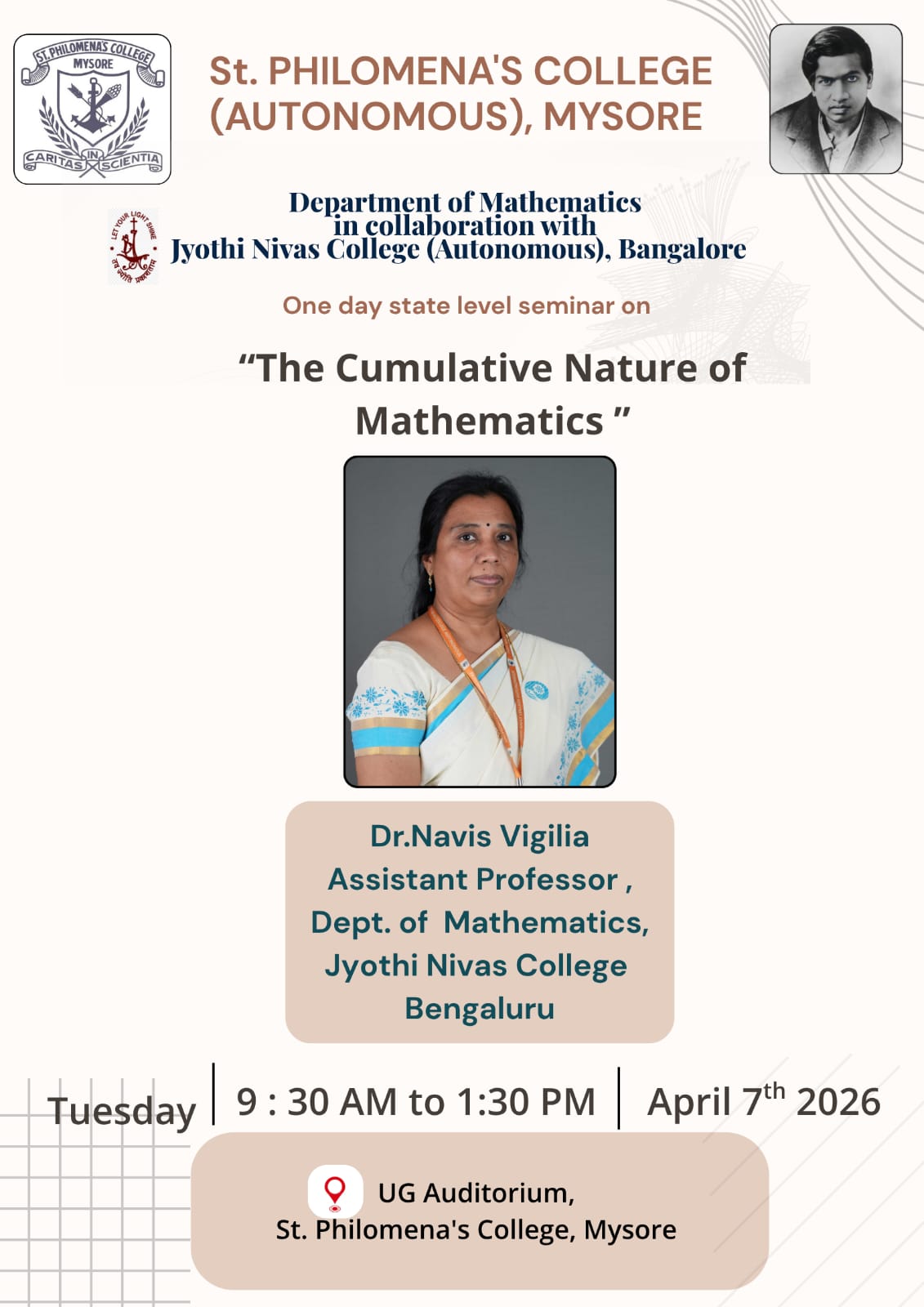
One-Day State Level Seminar on “The Cumulative Nature of Mathematics”
Date and Duration
Date: April 07, 2026
Time: 9:30 AM to 1:30 PM
Duration: One Day (4 Hours)
Venue
UG Auditorium, St. Philomena’s College (Autonomous), Mysuru
Organizing Department
UG Department of Mathematics, St. Philomena’s College (Autonomous), Mysuru
Collaborating Institution
Department of Mathematics, Jyothi Nivas College (Autonomous), Bengaluru
Resource Person
Dr. Navis Vigilia
Assistant Professor
Department of Mathematics
Jyothi Nivas College (Autonomous), Bengaluru
Target Audience
B.Sc. Students of St. Philomena’s College (Offline Mode)
Students of Jyothi Nivas College (Online Mode)
Number of Participants
Offline Participants: ………
Online Participants: ………
Objectives of the Programme
– To illustrate the cumulative and evolving nature of mathematical concepts.
– To introduce students to advanced topics in graph theory.
– To bridge the gap between theoretical mathematics and real-world applications.
– To encourage research orientation among undergraduate students.
Brief Description of the Programme
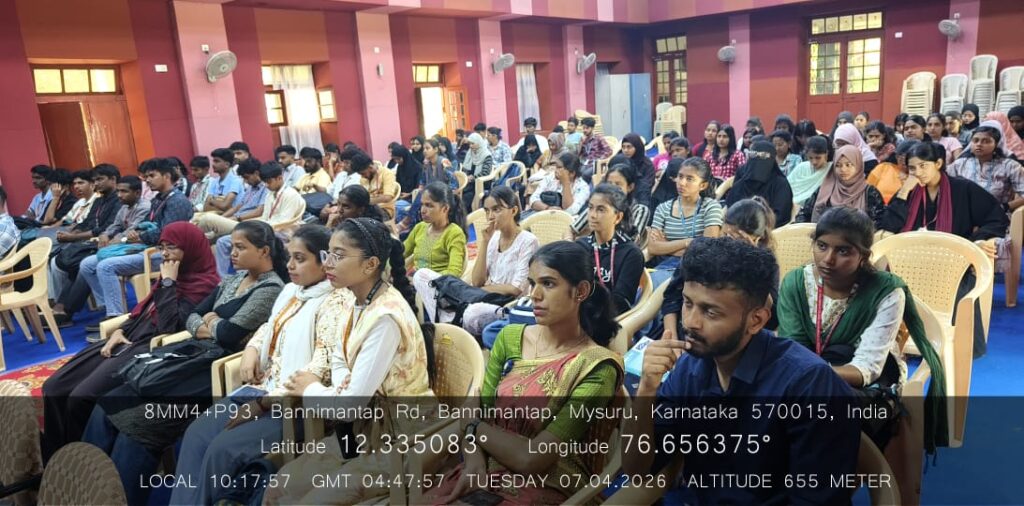
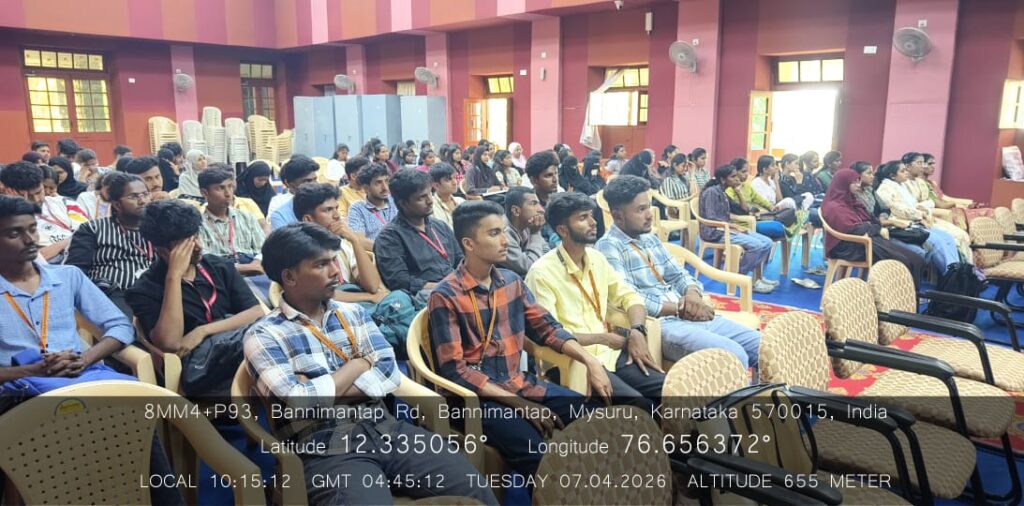
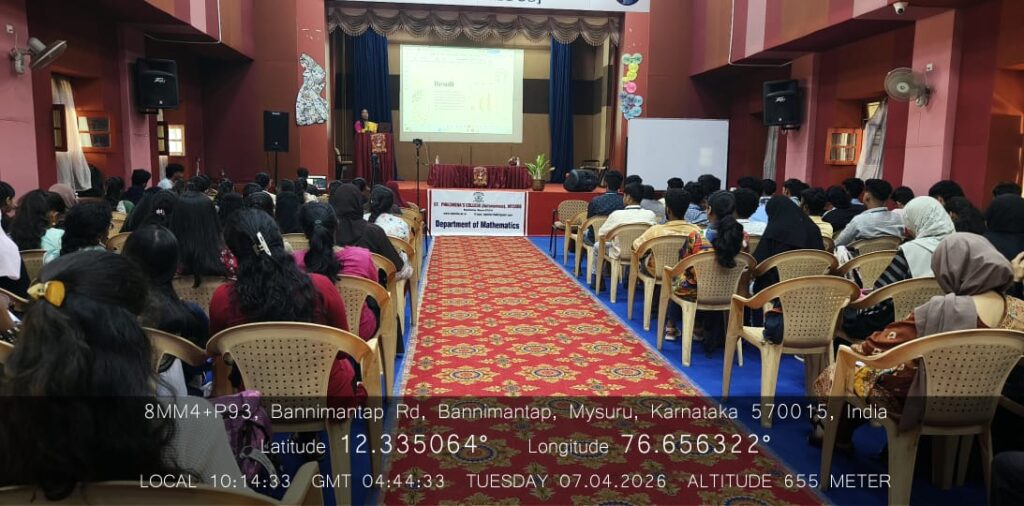
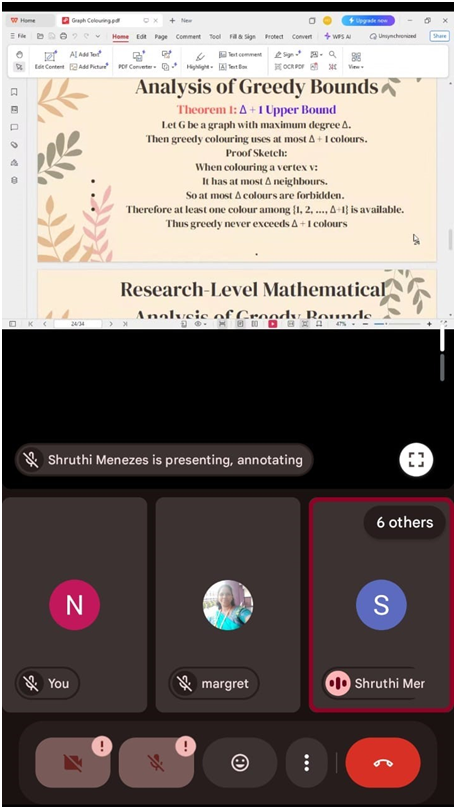
The UG Department of Mathematics, St. Philomena’s College (Autonomous), Mysuru, in collaboration with the Department of Mathematics, Jyothi Nivas College (Autonomous), Bengaluru, organized a one-day State Level Seminar on “The Cumulative Nature of Mathematics” on April 07, 2026.
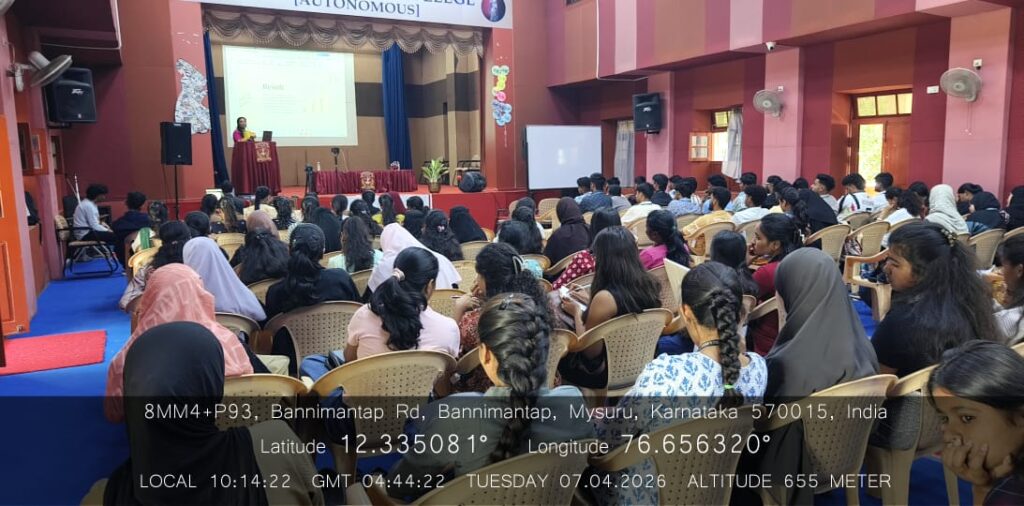
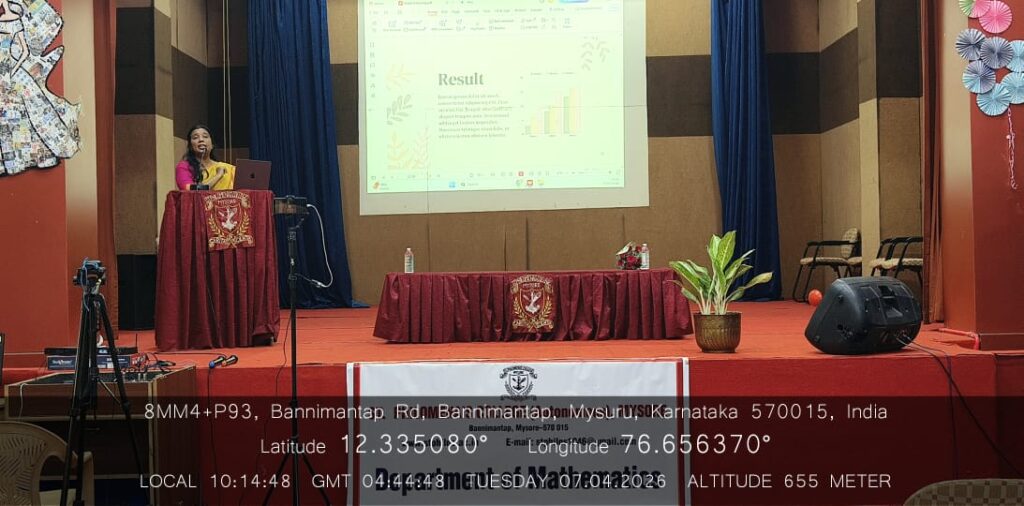
The seminar was conducted in a hybrid mode, enabling participation from students of both institutions. Dr. Navis Vigilia delivered a comprehensive lecture emphasizing the cumulative development of mathematical ideas.
Topics Covered
A. Fundamental & Theoretical Concepts
– Graph Coloring and Applications
– Planar Graphs and Euler’s Formula
– Hamiltonian and Eulerian Paths
– Matching Theory
– Graph Minors and Wagner’s Theorem
– Ramsey Theory
B. Advanced & Algorithmic Topics
– Spectral Graph Theory
– Temporal/Dynamic Graphs
– Random Graphs
– Graph Algorithms
– Network Reliability
C. Applications
– Social Network Analysis
– Biological Networks
– Logistics and Optimization
Methodology
Lecture-based presentation, interactive sessions, and hybrid participation.
Learning Outcomes
– Exposure to advanced graph theory concepts
– Improved analytical thinking
– Awareness of real-world applications
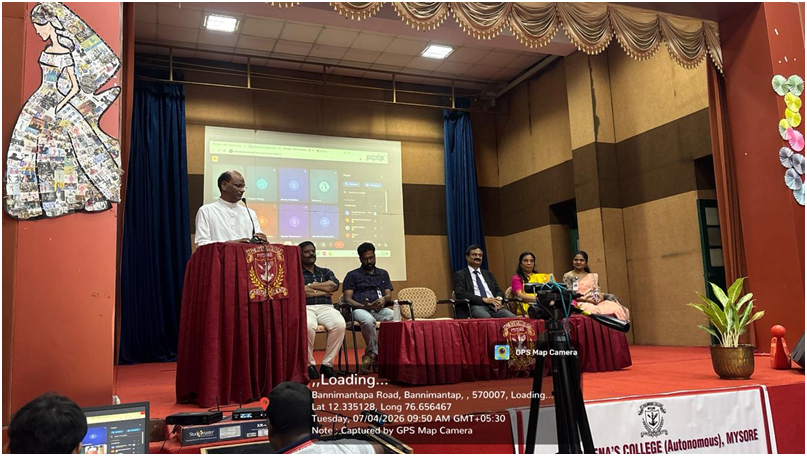
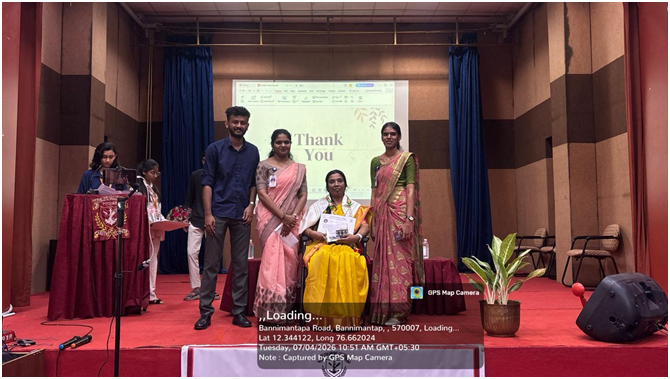
The seminar was inaugurated in the august gathering of Rev Fr. Lourdu Prasad Joseph , Rector, The Principal Dr Ravi J. D. Saldhana, Thomas Gunaseelan IQAC Coordinator, Resource Person DrNavis, HoDMrsShrutiMenzes and the faculty members of the department.
Elucidation of Technical Sessions
The technical sessions of the seminar were systematically structured to reflect the cumulative nature of mathematical concepts, progressing from foundational ideas to advanced theories and applications. The resource person, Dr.NavisVigilia, adopted a highly engaging and concept-oriented approach, ensuring clarity and continuity throughout the sessions.
Session I: Foundations of Graph Theory and Conceptual Framework
The session began with an introduction to graph theory as a powerful tool to model relationships and structures. The speaker emphasized how simple definitions of vertices and edges evolve into complex structures used in modern applications.
- Graph Coloring and Applications were introduced through real-life problems such as timetable scheduling and resource allocation. The concept of chromatic number was explained intuitively, followed by examples demonstrating vertex and edge coloring.
- The discussion moved to Planar Graphs and Euler’s Formula, where the classical relation between vertices, edges, and faces was illustrated using simple diagrams. The speaker gradually introduced deeper results such as Kuratowski’s Theorem, highlighting the characterization of planar graphs.
This session effectively laid the groundwork by connecting intuitive understanding with theoretical rigor.
Session II: Classical Problems and Structural Insights
In this session, the speaker explored historically significant problems that shaped graph theory.
- The concept of Eulerian Paths was introduced through the famous Seven Bridges of Königsberg problem, demonstrating how real-world puzzles led to the birth of graph theory.
- Hamiltonian Paths and Cycles were then discussed, with reference to optimization problems like the Travelling Salesman Problem. The contrast between Eulerian and Hamiltonian properties helped students understand different structural aspects of graphs.
- The session further covered Matching Theory, where Hall’s Marriage Theorem was explained with relatable examples, making abstract conditions more accessible.
The speaker ensured that each concept was built upon the previous one, reinforcing the cumulative learning process
Session III: Advanced Theoretical Developments
This session focused on deeper structural and theoretical aspects of graph theory.
- Graph Minors and Wagner’s Theorem were introduced to provide insight into how complex graphs can be understood through forbidden structures and decomposition techniques.
- The discussion on Ramsey Theory emphasized the idea that complete disorder is impossible, and patterns inevitably emerge in large systems. The speaker used simple examples to convey this profound concept.
- The transition from basic structures to abstract reasoning demonstrated how foundational ideas extend into advanced mathematical theories.
Session IV: Algorithmic and Computational Perspectives
The seminar then progressed towards algorithmic applications, linking theory with computation.
- The speaker explained Graph Algorithms such as Dijkstra’s algorithm for shortest paths, Kruskal’s algorithm for minimum spanning trees, and Ford–Fulkerson algorithm for maximum flow problems. Each algorithm was discussed conceptually, focusing on its logic and application rather than technical complexity.
- Spectral Graph Theory was introduced by explaining how matrices associated with graphs (adjacency and Laplacian) can be used to study graph properties through eigenvalues.
- The concept of Random Graphs using Erdős–Rényi models was discussed to show how networks behave under probabilistic settings.
- Temporal/Dynamic Graphs were presented to highlight real-world networks that evolve over time, such as transportation and communication systems.
This session effectively connected mathematical theory with computational techniques and modern research areas.
Session V: Applications and Interdisciplinary Relevance
The final session emphasized the practical importance of graph theory across disciplines.
- In Social Network Analysis, graphs were used to model relationships, identify clusters, and measure influence within networks.
- Biological Networks were discussed to demonstrate how graph theory helps in understanding neural connections and genetic interactions.
- Applications in Logistics and Optimization illustrated how mathematical models assist in route planning, supply chain management, and efficient resource utilization.
The speaker highlighted how abstract mathematical ideas find meaningful applications in solving real-world problems.
Pedagogical Approach
Throughout the sessions, the resource person adopted:
- A step-by-step explanatory method, ensuring smooth transition from basic to advanced topics
- Use of real-life examples and classical problems to enhance understanding
- Interactive questioning techniques to engage students actively
- A concept-driven approach rather than purely formula-based teaching
Student Engagement
Students actively participated by:
- Asking questions during and after each session
- Engaging in discussions on problem-solving approaches
- Relating theoretical concepts to practical scenarios
The hybrid mode also enabled online participants to interact effectively, ensuring inclusivity.
Summary of Session Progression
The seminar clearly demonstrated the cumulative progression of mathematics:
- Basic Definitions → Classical Problems → Structural Theorems → Algorithms → Applications
This structured flow helped students appreciate how mathematical knowledge evolves and interconnects across different domains.
Feedback and Response
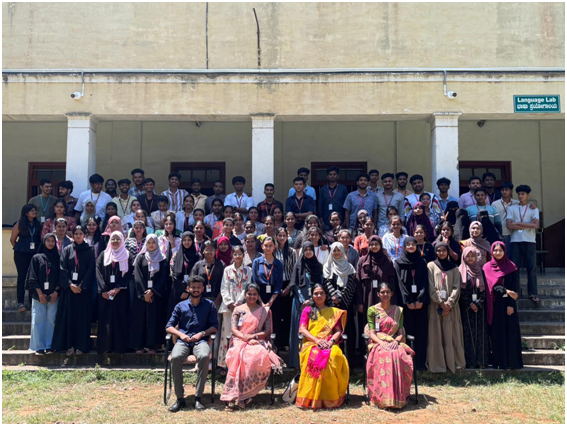
The seminar received positive feedback from participants.
Outcome / Impact
Enhanced academic collaboration and student engagement.
References Suggested
ReinhardDiestel – Graph Theory
Douglas B. West – Introduction to Graph Theory
Bondy and Murty – Graph Theory
Conclusion
The seminar successfully achieved its objectives and was academically enriching.
Attachments
Brochure, Attendance Sheets, Photographs
Signature
Convener
UG Department of Mathematics
St. Philomena’s College (Autonomous), Mysuru

You may also like
One Day National Level Seminar on

PI Day